| Multiple Hereditary Exostoses: Insights Into Pathogensis Was held November 3–5, 2005 Conference Program |
|

|

|

|

|

|

|

|

|

|

|

|

|

|
|

|

|

|

Sponsored By:
The National Institute of Health
The Shriners Hospitals
American Association of Enchondroma Diseases
March of Dimes Birth Defects Foundation
The Orthopaedic Research Society
Gene Dx DNA Dianostic Services
The Mizutani Foundation for Glycosciences
The National Institute of Health
The Shriners Hospitals
American Association of Enchondroma Diseases
March of Dimes Birth Defects Foundation
The Orthopaedic Research Society
Gene Dx DNA Dianostic Services
The Mizutani Foundation for Glycosciences
|

ORTHOPAEDICS AND CLINICAL GENETICS Chair (Christine Alvarez)
|

|

EXT FUNCTION AND NON-MAMMALIAN MODELS Chair (Scott Selleck)
|

|

BONE DEVELOPMENT Chair (Dan Wells)
EXOSTOSIS / DEVELOPMENT Chair (Jacqui Hecht)
|

|

|

NON-BONE PHENOTYPES Chair (Yu Yamaguchi)
|

|

|
|

|

|
|

The ABC’s of MHE: Chair (Sarah Ziegler)
| Composition of Organizing Committee Dan Wells, Ph.D., Professor at the University of Houston Dr. Wells is the former Chair of the Department of Biology and Biochemistry and the director of a NSF funded summer research program. He is currently President of the UH Sigma Xi Chapter and serves as a Scientific. He has helped organized multiple small meetings and symposia. Over the past fifteen years, Dr. Wells has 30 publications relevant to HME. Among his accomplishments in the HME field, Dr. Wells, together with Dr. Hecht, was the first to genetically map the EXT1 gene to 8q24.1. In addition, he positionally cloned and subsequently analyzed the EXT1 gene and developed the first knock-out mouse model for HME. Dr. Wells’ current research is aimed at understanding the molecular signaling involved in the etiology of HME. Jacqueline Hecht, Ph.D., Professor at the University of Texas-Houston Medical School Dr. Hecht is the Director of the Genetic Counseling Program, Department of Pediatrics, Division of Medical Genetics. She is a Ph.D. medical geneticist who provides clinical diagnostic expertise for all types of birth defects and specializes in skeletal dysplasias and HME. Her research has focused on identifying the molecular causes of HME and the effect of EXT mutations on the development of the exostoses. She has a strong interest in cartilage biology and studied the expression of cartilage-specific genes in the exostoses. Sarah Ziegler, National Director and Coordinator of Research, Executive Director of the National MHE Registry. Ms. Ziegler has been the driving force in developing a growing network of MHE researchers and clinicians that has resulted in several successful collaborations. She has been very involved in organizing researchers and physicians interested in the EXT gene, heparan sulfate formation, and developmental biology. Under the auspices of the National MHE registry samples of exostoses and other reagents are being studied in several laboratories to understand the etiology of the disease and potential mechanisms for controlling the growth of the exostoses. Ms. Ziegler has collaborated with researchers, developing questionnaire studies and obtaining participants from its membership. Studies include “Hereditary Multiple Exostoses and Pain: To what extent is pain associated with HME?” with the Jacqueline T. Hecht, Ph.D., University of Texas Houston Medical Center, the results of which indicated that pain in HME has been under-appreciated and must be addressed in the medical care of HME patients and with Yu Yamaguchi, M.D., Ph.D. of the Burnham Institute on “The Possible Relationship of Heparan Sulfate and Nerve Cell Function to Neurological Clinical Symptoms in patients with Multiple Hereditary Exostoses.” |
| Conference participants 2005 |
| Everything you need to know about Multiple Hereditary Exostoses workshop. Speakers included |
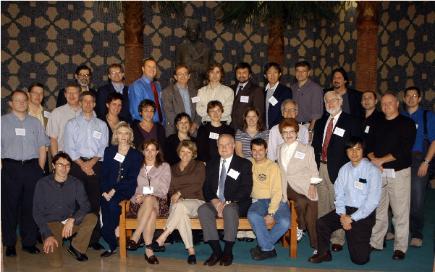
| [Photo courtesy of University of Texas Houston Medical Center taken during the 2005 conference] Top Row, Left to Right: Henry Kronenberg, M.D., Ben Alman, M.D., Matthew Hilton, Ph.D., Dan Wells, Ph.D., Wim Wuyts, Ph.D., Luca Sangiorgi, M.D., Ph.D., Yoshihiro Matsumoto, M.D., Rahul Warrior, Ph.D., Jeff Esko, Ph.D. Middle Row, Left to Right: T. Michael Underhill, Ph.D., Pancras Hogendoorn, M.D., Ph.D., David Ornitz,M.D., Ph.D., Brett Casey, M.D., Andrea Vortkamp, Ph.D., Marion Kusche-Gullberg, Ph.D., Catherine Merry, Ph.D., Malgorzata Wiweger, Ph.D., Melissa Rusch, Maurizio Pacifici, Ph.D., John Hassell, Ph.D.,Mohammad Shahnazari, Ph.D., Craig Eaton, Esq.,Jeremy Turnbull, Ph.D. Bottom Row, Left to Right: Dominique Stickens, Ph.D., Sarah Ziegler, Christine Alvarez, M.D., Jacqueline Hecht, Ph.D.,George Thomson, M.D., Scott Selleck, M.D., Ph.D., Yu Yamaguchi, M.D., Ph.D. Not Pictured: John E. Herzenberg, M.D., Harish S. Hosalkar, M.D., Ashish Sinha, M.D., Ph.D., Sandra Darilek, M.S. |
HME-RELATED DISEASES Chair (Benjamin Alman)

Introduction of orthopaedics and defining severity of Hereditary Multiple Exostosis.
Clinical treatments and surgical procedures.
Mutation detection strategies for molecular screening in patients.
Mutational analysis and clinical expression of disease in patients with HME.
FGF binding to percelan isolated from the growth plate.
FGF that regulate growth plate development.
Syndecans: Cell surface modulators of growth plate chondrocytes.
Delineation of regulatory networks underlying BMP action in chondrogensis.
How PTHrP regulates chondrocytes in the growth plate.
Ihh signaling in the growth plate.
Multiple Aspects of Ihh Signaling in the Endochondral Skeleton.
Analysis of human exostoses and derived cells.
Signaling defects in chondrocytes give rise to exostoses.
Mice deficient in EXT2 lack heparan sulfate and develop exostoses.
Profiling of osteochondromas and peripheral chondrosarcomas.
EXT1 and EXT2 proteins and heparan sulfate biosynthesis.
Heparan sulfate biosynthesis and sulfation.
ES Cells and the role of Heparan Sulphate in Development and Disease.
Developmental regulation of HSPG synthesis during Drosophila
Zebrafish as a model for studies on Hereditary Multiple Exostosis.
Phenotypes of conditional EXT1 knockout mice: Non-skeletal symptoms.
Structure and biosynthesis of mouse brain heparan sulfate.
Keloid Formation Following Surgical Treatment of MHE.
p53 and Rb in Cartilage Tumors in Mice.
Tibia Dyschondroplasia; Ihh signaling.
Olliers and Mafucci.
Presenting study results, "Hereditary Multiple Exostoses
and Pain".
and Pain".
Use of Fixators, MHE / MO / HME

| 2005 MHE Research Conference |
| |||||||||||||||||||||||||||||||||||||||||||||||||||||||||||||||||||||||||||||||||||||||||||||||||||||||||||||||||||||||||||||||||||||||||||||||||||||||||||||||||||||||||||||||||||||||||||||||||||||||||||||||||||


| |||||||||||
| The MHE Research Foundation video player above these videos are formated in Flash Media. Click the icon > to start viewing the video. Click the icon >> to view the next video or use the play list. Depending on your web browser and Internet connection speed, it may take a few minutes to load. If the video seems a little slow please use the individual links below. Internet Explorer users the links below for windows media player may load faster. Our Foundation has put the videos into multiple formats to make it easier for all of our users to view not matter what Internet connection or computer you are using MAC or PC. |

The MHE Research Foundation, we comply with the HONcode standard for health trust worthy information: By the Health On the Net Foundation.
Click here to verify.# HON Conduct 282463 and is the patient support link on the US Government Genetics Home Reference (http://ghr.nlm.nih.gov)
website, also linked for Patient Information on The Diseases Database a cross-referenced index of human disease, as well as the
Intute: health & life sciences a free online service providing access to the very best Web resources for education and research located in the UK
Click here to verify.# HON Conduct 282463 and is the patient support link on the US Government Genetics Home Reference (http://ghr.nlm.nih.gov)
website, also linked for Patient Information on The Diseases Database a cross-referenced index of human disease, as well as the
Intute: health & life sciences a free online service providing access to the very best Web resources for education and research located in the UK
The MHE Research Foundation is proud to be working with the EuroBoNeT consortium, a European Commission granted Network of Excellence for
studying the pathology and genetics of bone tumors.
studying the pathology and genetics of bone tumors.
| This website is regularly reviewed by members of the Scientific and Medical Advisory Board of the MHE Research Foundation. All online submission forms use (SSL AES 256 bit encryption (High); RSA 1024 bit exchange) Protocol with Privacy protection. Our goal is to make this website as safe and user friendly as possible. |


| The MHE Research Foundation is a participating member organization of the United States Bone and Joint Decade, (USBJD) & the USBJD Rare Bone Disease Patient Network |
| Written consent must be obtained to attach web pages or the files attached to this website, please email the webmaster. Email the webmaster: webmaster@mheresearchfoundation.org Materials on this website are protected by copyright Copyright © 2009 The MHE Research Foundation Disclaimer: While many find the information useful, it is in no way a substitute for professional medical care. The information provided here is for educational and informational purposes only. This website does not engage in the practice of medicine. In all cases we recommend that you consult your own physician regarding any course of treatment or medicine. This web page was updated last on 12/16/09, 4:0O pm Eastern time |


The MHE Research Foundation is proud to be an affiliate of the Society For Glycobiology


