

| Announcement Page |
| MHERF Non Research Related Announcements |
Article 12 / 1 / 06 Medieval Ballyhanna
Medieval skeletal remains of an 800 year-old Ballyshann man with MHE. Click Here
Medieval skeletal remains of an 800 year-old Ballyshann man with MHE. Click Here
| Orthopaedic Conference IPOS Announcements 2008/2009/2010 |
| Research Project Open |

| Press Release Publication Announcements during 2007 |
Press Release 05 / 21 / 07
The MHE Research Foundation is honored that Miss Markham, Ontario Bianca Mondino has chosen to become an
ambassador for our foundation. Bianca’s ability to bring awareness concerning this rare medical condition is truly a gift to all
who suffer from MHE / MO / HME. She is a national delegate representing the city of Markham, Ontario in the upcoming Miss
Canada International Scholarship Pageant. Where young ladies are not solely judged on beauty and body image, importance is
also placed on personality, intellect, public speaking, and community involvement. Bianca Mondino’s choice of the MHE Research
Foundation is very close to her heart as she underwent surgery when she was younger to remove Osteochondromas due to
the fatigue and pain this condition caused her. Her commitment and understanding towards research being conducted today
brings hope that one day a treatment will be found and others will no longer need to suffer from this very painful condition.
She is truly an inspiration to us all and for more information about Bianca and her goals please Click Here
The MHE Research Foundation is honored that Miss Markham, Ontario Bianca Mondino has chosen to become an
ambassador for our foundation. Bianca’s ability to bring awareness concerning this rare medical condition is truly a gift to all
who suffer from MHE / MO / HME. She is a national delegate representing the city of Markham, Ontario in the upcoming Miss
Canada International Scholarship Pageant. Where young ladies are not solely judged on beauty and body image, importance is
also placed on personality, intellect, public speaking, and community involvement. Bianca Mondino’s choice of the MHE Research
Foundation is very close to her heart as she underwent surgery when she was younger to remove Osteochondromas due to
the fatigue and pain this condition caused her. Her commitment and understanding towards research being conducted today
brings hope that one day a treatment will be found and others will no longer need to suffer from this very painful condition.
She is truly an inspiration to us all and for more information about Bianca and her goals please Click Here
Press Release 03 / 06 / 07
JNCI Journal of the National Cancer Institute 2007 99(5):396-406; doi:10.1093/jnci/djk067
To read journal full publication Click Here
EXT1 Gene Influences Formation of Nonhereditary Benign Bone Tumors
Mutations in a gene known as EXT1 cause Multiple Osteochondromas, a rare hereditary disorder that results in the formation of
benign cartilage-covered bone tumors. Now scientists have shown that EXT1 is also involved in the development of
nonhereditary osteochondromas, the more common form of the disease.
Liesbeth Hameetman of Leiden University Medical Center in The Netherlands, and colleagues examined eight nonhereditary
osteochondromas to determine whether EXT1 acts as a tumor-suppressing gene in nonhereditary osteochondromas in the
same way it does in hereditary ones. Mutations or deletions of tumor suppressor genes increased the likelihood of a cell
becoming a tumor cell, but both copies of the gene had to be affected for this to happen.
In seven of the eight osteochondromas, both copies of EXT1 were deleted; these deletions occurred only in the cartilage cap of
the one osteochondroma that was examined in detail. Previous studies demonstrated that the cartilage cap was formed of
tumor tissue, but it was unknown whether other parts of the osteochondromas—the bony stalk and the connective tissue—
were as well. The authors conclude that EXT1 acts as a tumor suppressor gene in the cartilage of nonhereditary
osteochondromas.
“Our finding that the cartilage cap is the only [tumor] component of osteochondroma revives long-standing debate about the
cell origin of osteochondromas,” the authors write.
The MHE Research Foundation would like to thank Dr. Hogendoorn and his colleagues for all their long standing research efforts.
These research findings have paramount importance to the field of MHE / MO / HME research. MHERF would also like to thank
Dr. Hogendoorn for always staying in such close contact with our organization and for all his support. Also for being given this
opportunity to be the first organization besides the JNCI Journal of the National Cancer Institute to help announce these
research findings.
JNCI Journal of the National Cancer Institute 2007 99(5):396-406; doi:10.1093/jnci/djk067
To read journal full publication Click Here
EXT1 Gene Influences Formation of Nonhereditary Benign Bone Tumors
Mutations in a gene known as EXT1 cause Multiple Osteochondromas, a rare hereditary disorder that results in the formation of
benign cartilage-covered bone tumors. Now scientists have shown that EXT1 is also involved in the development of
nonhereditary osteochondromas, the more common form of the disease.
Liesbeth Hameetman of Leiden University Medical Center in The Netherlands, and colleagues examined eight nonhereditary
osteochondromas to determine whether EXT1 acts as a tumor-suppressing gene in nonhereditary osteochondromas in the
same way it does in hereditary ones. Mutations or deletions of tumor suppressor genes increased the likelihood of a cell
becoming a tumor cell, but both copies of the gene had to be affected for this to happen.
In seven of the eight osteochondromas, both copies of EXT1 were deleted; these deletions occurred only in the cartilage cap of
the one osteochondroma that was examined in detail. Previous studies demonstrated that the cartilage cap was formed of
tumor tissue, but it was unknown whether other parts of the osteochondromas—the bony stalk and the connective tissue—
were as well. The authors conclude that EXT1 acts as a tumor suppressor gene in the cartilage of nonhereditary
osteochondromas.
“Our finding that the cartilage cap is the only [tumor] component of osteochondroma revives long-standing debate about the
cell origin of osteochondromas,” the authors write.
The MHE Research Foundation would like to thank Dr. Hogendoorn and his colleagues for all their long standing research efforts.
These research findings have paramount importance to the field of MHE / MO / HME research. MHERF would also like to thank
Dr. Hogendoorn for always staying in such close contact with our organization and for all his support. Also for being given this
opportunity to be the first organization besides the JNCI Journal of the National Cancer Institute to help announce these
research findings.
Press Release 04 / 09 / 07
Abnormal Scarring With Keloid Formation After Osteochondroma Excision in Children With Multiple Hereditary
Exostoses.
Journal of Pediatric Orthopaedics. 27(3):333-337, April/May 2007.
To read journal abstract or full publication Click Here
Harish Hosalkar, MD, MBMS (Ortho), FCPS (Ortho), DNB (Ortho); Jared Greenberg, MD; Rebecca L. Gaugler, BS; Sumeet Garg,
MD; John P. Dormans, MD
Discussion: Abnormal scarring with keloid formation after osteochondroma excision in MHE has not been previously reported.
Although this study has limited numbers, the results demonstrate a statistically significant correlation between keloid formation
and MHE. The risk for abnormal scarring and keloid formation should be discussed with all patients before surgery.
The MHE Research Foundation greatly appreciates Dr. Dormans, who serves on the Scientific and Medical Advisory Board of
MHERF and all colleagues who conducted this research, as many people living with MHE / MO / HME have been experiencing this
problem of keloid formation after osteochondroma excision. Our hope that this research will help educate both the medical
and MHE / MO / HME communities, all should be award that this issue of abnormal scarring is taking place.
Abnormal Scarring With Keloid Formation After Osteochondroma Excision in Children With Multiple Hereditary
Exostoses.
Journal of Pediatric Orthopaedics. 27(3):333-337, April/May 2007.
To read journal abstract or full publication Click Here
Harish Hosalkar, MD, MBMS (Ortho), FCPS (Ortho), DNB (Ortho); Jared Greenberg, MD; Rebecca L. Gaugler, BS; Sumeet Garg,
MD; John P. Dormans, MD
Discussion: Abnormal scarring with keloid formation after osteochondroma excision in MHE has not been previously reported.
Although this study has limited numbers, the results demonstrate a statistically significant correlation between keloid formation
and MHE. The risk for abnormal scarring and keloid formation should be discussed with all patients before surgery.
The MHE Research Foundation greatly appreciates Dr. Dormans, who serves on the Scientific and Medical Advisory Board of
MHERF and all colleagues who conducted this research, as many people living with MHE / MO / HME have been experiencing this
problem of keloid formation after osteochondroma excision. Our hope that this research will help educate both the medical
and MHE / MO / HME communities, all should be award that this issue of abnormal scarring is taking place.
Press Release 04 / 14 / 07
A combined analytical approach reveals novel EXT1/2 gene mutations in a large cohort of Italian multiple
osteochondromas patients.
Journal of Genes, Chromosomes and Cancer. DOI: 10.1002/gcc.20431
To read full publication Click Here
Emanuela Signori 1 *, Emanuela Massi 1, Maria Giovanna Matera 2, Monica Poscente 3, Carolina Gravina 2, Gianluca Falcone 4,
Michele Attilio Rosa 5, Monica Rinaldi 6, Wim Wuyts 7, Davide Seripa 2, Bruno Dallapiccola 8, Vito Michele Fazio 1 2, Clinical
reference groups§
Dr. Fazio and his colleagues took a cohort of 100 MO patients belonging to unrelated Italian families, they were analyzed by
single-strand conformation polymorphism (SSCP) analysis or by denaturing high performance liquid chromatography (DHPLC).
However, neither of these techniques can detect deletions or duplications of entire exons. Families that were negative at
SSCP/DHPLC analysis underwent two-color multiple ligation-dependent probe amplification (MLPA) analysis. By these
complementary techniques mutation detection was significantly improved and 26 novel mutations have been revealed as well as
18 previously described mutations to give a total of 44 different mutations. Thus Dr. Fazio concludes that combining MLPA with
DHPLC in point-mutations negative MO families, the detection of mutations in EXT genes can significantly improve the
identification of both point-mutations and mid-size rearrangements. More important, we were able to characterize all those
patients who were negative at the first PCR-based method screening.
The MHE Research Foundation would like to thank Dr. Fazio for thoughtfully acknowledging families, parents, and children,
MHERF and our foundation's National Director of Research Sarah Zielger as well as A.C.A.R. in this publication. The MHE
Research Foundation sees first hand, Sarah's tireless efforts, on behalf of all affected by MHE / MO / HME. MHERF firmly believes
all of our combined
efforts are now and will in the future continue to off. Thanks Again on behalf of MHERF and all people affected by MHE / MO /
HME for all your dedication.
A combined analytical approach reveals novel EXT1/2 gene mutations in a large cohort of Italian multiple
osteochondromas patients.
Journal of Genes, Chromosomes and Cancer. DOI: 10.1002/gcc.20431
To read full publication Click Here
Emanuela Signori 1 *, Emanuela Massi 1, Maria Giovanna Matera 2, Monica Poscente 3, Carolina Gravina 2, Gianluca Falcone 4,
Michele Attilio Rosa 5, Monica Rinaldi 6, Wim Wuyts 7, Davide Seripa 2, Bruno Dallapiccola 8, Vito Michele Fazio 1 2, Clinical
reference groups§
Dr. Fazio and his colleagues took a cohort of 100 MO patients belonging to unrelated Italian families, they were analyzed by
single-strand conformation polymorphism (SSCP) analysis or by denaturing high performance liquid chromatography (DHPLC).
However, neither of these techniques can detect deletions or duplications of entire exons. Families that were negative at
SSCP/DHPLC analysis underwent two-color multiple ligation-dependent probe amplification (MLPA) analysis. By these
complementary techniques mutation detection was significantly improved and 26 novel mutations have been revealed as well as
18 previously described mutations to give a total of 44 different mutations. Thus Dr. Fazio concludes that combining MLPA with
DHPLC in point-mutations negative MO families, the detection of mutations in EXT genes can significantly improve the
identification of both point-mutations and mid-size rearrangements. More important, we were able to characterize all those
patients who were negative at the first PCR-based method screening.
The MHE Research Foundation would like to thank Dr. Fazio for thoughtfully acknowledging families, parents, and children,
MHERF and our foundation's National Director of Research Sarah Zielger as well as A.C.A.R. in this publication. The MHE
Research Foundation sees first hand, Sarah's tireless efforts, on behalf of all affected by MHE / MO / HME. MHERF firmly believes
all of our combined
efforts are now and will in the future continue to off. Thanks Again on behalf of MHERF and all people affected by MHE / MO /
HME for all your dedication.
All BLUE Links & website tabs are active and checked weekly, if you happen to click a link that is not working please notify using
this comment form link or email the master at webmaster@mheresearchfoundation.org Thank you
this comment form link or email the master at webmaster@mheresearchfoundation.org Thank you
Press Release 1 / 10 / 08
Our foundation is pleased to announce MHE / MO / HME is now included in the NLM website Genetics Home Reference, Your
Guild to understanding Genetic Conditions. The Genetics Home Reference provides access to information from the National
Library of Medicine (NLM), the National Institutes of Health, and other U.S. Government agencies. Our foundation hopes now
government agencies, like the Social Security Administration and others will have an easier time looking up the MHE disease
information needed when people with MHE need to apply for benefits.
Our foundation requested that a section on MHE be added to this website and that all websites providing patient information be
reviewed during this process, Our foundation is the only MHE pacific patient support organization listed, as we meet all of the
criteria as required. There are only about 250 genetic conditions that have sections located on this website. To view this website
Click Here
Our foundation is pleased to announce MHE / MO / HME is now included in the NLM website Genetics Home Reference, Your
Guild to understanding Genetic Conditions. The Genetics Home Reference provides access to information from the National
Library of Medicine (NLM), the National Institutes of Health, and other U.S. Government agencies. Our foundation hopes now
government agencies, like the Social Security Administration and others will have an easier time looking up the MHE disease
information needed when people with MHE need to apply for benefits.
Our foundation requested that a section on MHE be added to this website and that all websites providing patient information be
reviewed during this process, Our foundation is the only MHE pacific patient support organization listed, as we meet all of the
criteria as required. There are only about 250 genetic conditions that have sections located on this website. To view this website
Click Here
Press Release 05 / 21 / 07 4:00 pm eastern time
Conditional Kif3a ablation causes abnormal hedgehog signaling topography, growth plate dysfunction, and
excessive bone and cartilage formation during mouse skeletogenesis
Development 2007 134: 2159-2169.
To read journal full publication Click Here
Eiki Koyama, Blanche Young, Motohiko Nagayama, Yoshihiro Shibukawa, Motomi Enomoto-Iwamoto, Masahiro Iwamoto, Yukiko
Maeda, Beate Lanske, Buer Song, Rosa Serra, and Maurizio Pacifici
Sarah Ziegler National Director of Research: I had the opportunity to visit with Dr. Pacifici in his lab last July and meet with him
again this past April. We had the chance to speak about the research Dr. Pacifici has just published and the impact that this
research has on MHE / MO /HME. Dr. Pacifici and I spoke about the MHE / MO / HME research direction he and colleagues are
now going to take in the next few years as well. MHE / MO / HME is truly lucky to have such notable researchers many of whom
sever on our Scientific Advisory Board searching for the answers to some very very large questions. The entire etiology of MHE
/ MO / HME must be better understood and the research paper that Dr. Pacifici has just published has brought us one step
closer.
There are times in a ones life when they need reflection, a chance to look at where we were, where we are and where we want
to be. When I first started my work, it was with plain simple blind hope and faith that with the efforts of many that one day a
treatment could be found. Now I can see after eight years that the blind hope has been replaced with research facts and these
facts now show me that indeed a treatment is within our REACH and hope burns brighter and faith runs deeper then ever. The
direction the Scientific & Medical Advisory Board is taking MHE / MO / HME research in is correct. It is only by carefully choosing
the steps we take, that one day a treatment for MHE / MO / MHE can be found. Again this is going to take the efforts of many
and time, but boy does the future look bright!!!
Conditional Kif3a ablation causes abnormal hedgehog signaling topography, growth plate dysfunction, and
excessive bone and cartilage formation during mouse skeletogenesis
Development 2007 134: 2159-2169.
To read journal full publication Click Here
Eiki Koyama, Blanche Young, Motohiko Nagayama, Yoshihiro Shibukawa, Motomi Enomoto-Iwamoto, Masahiro Iwamoto, Yukiko
Maeda, Beate Lanske, Buer Song, Rosa Serra, and Maurizio Pacifici
Sarah Ziegler National Director of Research: I had the opportunity to visit with Dr. Pacifici in his lab last July and meet with him
again this past April. We had the chance to speak about the research Dr. Pacifici has just published and the impact that this
research has on MHE / MO /HME. Dr. Pacifici and I spoke about the MHE / MO / HME research direction he and colleagues are
now going to take in the next few years as well. MHE / MO / HME is truly lucky to have such notable researchers many of whom
sever on our Scientific Advisory Board searching for the answers to some very very large questions. The entire etiology of MHE
/ MO / HME must be better understood and the research paper that Dr. Pacifici has just published has brought us one step
closer.
There are times in a ones life when they need reflection, a chance to look at where we were, where we are and where we want
to be. When I first started my work, it was with plain simple blind hope and faith that with the efforts of many that one day a
treatment could be found. Now I can see after eight years that the blind hope has been replaced with research facts and these
facts now show me that indeed a treatment is within our REACH and hope burns brighter and faith runs deeper then ever. The
direction the Scientific & Medical Advisory Board is taking MHE / MO / HME research in is correct. It is only by carefully choosing
the steps we take, that one day a treatment for MHE / MO / MHE can be found. Again this is going to take the efforts of many
and time, but boy does the future look bright!!!
Press Release 1 / 19 / 08
Mutation Screening of EXT1 and EXT2 by Denaturing High-Performance Liquid Chromatography, Direct Sequencing
Analysis, Fluorescence in Situ Hybridization, and a New Multiplex Ligation-Dependent Probe Amplification Probe Set
in Patients with Multiple Osteochondromas
Ivy Jennes*, Mark M. Entius{dagger}, Els Van Hul*, Alessandro Parra{ddagger}, Luca Sangiorgi{ddagger} and Wim Wuyts*
To Read this publication Click Here
Both Luca Sangiorgi, M.D., Ph.D. and Wim Wuyts, Ph.D. are members of our Scientific & Medical Advisory Board and our
foundation helped support this research
Mutation Screening of EXT1 and EXT2 by Denaturing High-Performance Liquid Chromatography, Direct Sequencing
Analysis, Fluorescence in Situ Hybridization, and a New Multiplex Ligation-Dependent Probe Amplification Probe Set
in Patients with Multiple Osteochondromas
Ivy Jennes*, Mark M. Entius{dagger}, Els Van Hul*, Alessandro Parra{ddagger}, Luca Sangiorgi{ddagger} and Wim Wuyts*
To Read this publication Click Here
Both Luca Sangiorgi, M.D., Ph.D. and Wim Wuyts, Ph.D. are members of our Scientific & Medical Advisory Board and our
foundation helped support this research
This website loads much faster using Fire Fox web browser download link You will also not need to use the tool bar scroll.
People using Internet Explorer: To use the full drop down tool bar you will need to move your mouse over the tool bar and use
the small scroll located on the right hand of this web page. For more detailed website user information link,
People using Internet Explorer: To use the full drop down tool bar you will need to move your mouse over the tool bar and use
the small scroll located on the right hand of this web page. For more detailed website user information link,
Press Release 2 / 13 / 08
Multiple osteochondromas
Judith V.M.G. Bovée
Orphanet Journal of Rare Diseases 2008, 3:3 (13 February 2008)
To Read this publication Click Here
Multiple osteochondromas
Judith V.M.G. Bovée
Orphanet Journal of Rare Diseases 2008, 3:3 (13 February 2008)
To Read this publication Click Here
Identification and characterization of genes and molecular mechanisms causing multiple osteochondroma
(MHE/MO/HME) and related bone disorders, Clinical and molecular study of factors implicated in Multiple Osteochondroma
(MHE/MO/HME). It is only by the collection of large numbers of samples and data that major progress can be made in human
study of MHE.
Tumor samples are needed!, if you are under going surgery please let us know,The MHE Research Foundation and the
Researchers working on this project would like your help.Please consider participating in the project. It does not cost you any
thing to participate. Please consider completing the on-line clinical questionnaire, full details can be read by clicking the tabs
below. You do not need to be having surgery to fill out this questionnaire. All people with MHE are needed. This research project
is not simply depending on samples & data from people with MHE / MO / HME that visit this website, this research project is
obtaining samples & data directly from hospitals around the USA and multiple countries.
How ever you are a very important part of this approach and your help is greatly needed. There has been major problem in
human studies up until now. This was mainly due to the low number of available samples in previous studies and the lack of a
uniform phenotype scoring systems used. With the construction of this large MHE / MO / HME network these problems have
been addressed and by pooling these samples (construction of a tissue bank) and data of MHE / MO / HME patients & uniform
phenotype scoring system. These researchers are also in contact with researchers using animal models to study MHE / MO /
HME, together we feel that even larger gains will be made in the future. Together this approach will help greatly in achieving a
much better understand of MHE / MO / HME. Research can now move forward in a more comprehensive direction.
The MHE Research Foundation will be collaborating on this new research project with the following researchers listed below.
These researchers are partners of the EuroBoneT consortium, a European Commission granted Network of Excellence for
studying the pathology and genetics of bone tumors. The researchers heading up this project are being assisted by other
researchers in this field. All study information is coded and personal identifiers are removed.
This foundation gives full detailed disclosure, including signed agreements between this foundation and researchers. We also
give full back round information of these researchers. We believe you should know where and how this data is being used. This
foundation will never simply request for participation without full and detailed information.
One question many people have is why Belgium, Italy and Netherlands? Because most labs do not invest in laborious and
expensive techniques to identify mutations which are not found by standard mutation analysis of EXT1 and EXT2. To identify a
potential EXT1 or EXT2 mutation, negative patients are analyzed with the most sensitive techniques, including RNA and
promotor analysis to identify intronic or regulatory mutation.
The identification of mutations in regulatory regions may point to sequences crucial for proper EXT regulation and these
sequences can be used as targets for the identification of proteins regulating EXT expression. Most research that has been
done in humans used only two step approach, standard genetic testing and clinical information or standard genetic testing and
the study of tumors. This research is using comprehensive genetic testing techniques, pathology, studying chondrocytes
isolated from the exostoses and clinical information as well as the additional clues that come from animal models. Funding is also
an issue, human genetics study into MHE / MO / HME is not being funded by the National Institute of Health, hence the vast
amount of this type of research is not done in the United States.
Pancras C.W. Hogendoorn, MD, PhD years of experience in pathology and genetics of bone tumors has paid off ! He's the
leader of the EuroBoneT consortium, a European Commission granted Network of Excellence for studying the pathology and
genetics of bone tumors and the use of comprehensive genetic testing methods & techniques. Wim Wuyts , PH.D. has
researched for years by comprehensively studying genetics in MHE / MO / HME and by using these state of the art genetic
testing methods & techniques as well and was one of the first researchers to discover the first of the two genes that causes
MHE / MO / HME. Luca Sangiorgi, M.D., PH.D. has also been using comprehensive genetic testing techniques in his research, the
Rizzoli Orthopaedic Institute has a clinic set up for MHE / MO / HME. Dr. Sangiorgi is also Coordinator of the Italian Registry of
Hereditary Multiple Exostoses as well. All of these researchers sever as advisors to family support groups in there countries. Dr.
Wuyts and Dr. Sangiorgi Scientific sever on the Scientific and Medical Board of this Foundation and we are working very very
closely with Dr. Hogendoorn as well.
Simply put! this is a DREAM TEAM conducting this research with state of the art testing methods & techniques when it comes
to genetics and pathology in the world of MHE / MO / HME research!. MHE / MO / HME research deserves the best and does not
have to settle for less. They all understand and are deeply concerned about quality of life issues people with MHE / MO / HME
face every day, thus can incorporate this into research. The MHE Research Foundation is in a uniquely qualified position of be
able to help bring research forward and address quality of life issues within research it self. Working directly with researchers
allows us to give insight into secondary symptoms that have been over looked in many clinical settings. As important if not
more important having direct contact with so many people living with MHE / MO / HME enables us to help address quality of life
issues in this research settings as well. This was clearly illustrated by Sarah Ziegler, MHE Research Foundation's National
Director of Research in the presentation she gave at the Connective Tissue Oncology Society conference Nov 2006 held in
Venice Italy. (When clicking CTOS link it will take a few minutes to load as there is a large amount of data located on this
webpage)
This is a well balanced comprehensive research approach, the first of its kind. It is this foundation's hope by giving detailed
information about this research project and the How's and Why's that will lead people with MHE / MO / HME to want to
participate in MHE / MO / HME Research. By bring both the MHE / MO / HME community and the Orthopaedic community
together, the numbers of samples and data will add up and ultimately make this research bear more fruit in the future.
EuroBoNet executive summary PDF file LINK
Pancras C.W. Hogendoorn, MD, PhD Principle Researcher MHERF research registry
Professor of Pathology,
Department of Pathology, Leiden University Medical Center,
Molecular tumor pathology and tumor genetics, Netherlands.
Chairman of EuroBoNeT consortium, a European Commission granted Network of Excellence for studying the pathology and
genetics of bone tumors.
Wim Wyuts, PH.D. Principle Researcher MHERF research registry
Supervisor DNA Diagnostics,
Department of Medical Genetics University
and University Hospital of Antwerp, Belgium
Partner in the EuroBoNeT consortium, a European Commission granted Network of Excellence for studying the pathology and
genetics of bone tumors.
Luca Sangiorgi, M.D., PH.D. Principle Researcher MHERF research registry
Head of the Genetics Unit, Lab Oncology Research,
Coordinator, Rare Skeletal Diseases,
Rizzoli Orthopaedic Institute, Bologna, Italy
Coordinator of the Italian Registry of Hereditary Multiple Exostoses
Coordinator Virtual Lab of Bioinformatics for Genetics and Biotech (Gebba-Lab)
Partner in the EuroBoNeT consortium, a European Commission granted Network of Excellence for studying the pathology and
genetics of bone tumors.
Project description:
Identification and characterization of genes and molecular mechanisms causing multiple osteochondroma (MHE / MO / HME) and
related bone disorders, Clinical and molecular study of factors implicated in Multiple Osteochondroma (MHE / MO / HME).
Project aims:, the identification and study of genes involved in the disorder Multiple Osteochondroma (MO) / Multiple Hereditary
Exostoses (MHE). MHE / MO / HME is a hereditary bone disorder characterized by the presence of bony outgrowths
(osteochondromas / exostoses) on the long bones. MHE / MO / HME patients suffer from pain caused by the pressure of the
osteochondromas / exostoses on neighboring tissues, organs or nerves. Often MHE / MO / HME patients also show skeletal
deformities. However, great clinical variability is observed between the various patients, even within one family.
It has been shown that mutations in one of two genes, EXT1 or EXT2, are responsible for the majority of MHE / MO / HME
cases. However, the exact mechanism leading to the development of osteochondromas is still not fully understood.
This project concentrates on the molecular aspects of MHE / MO / HME. Tumor and blood samples and data of MHE / MO / HME
patients are collected and studied to see how they differ from samples from healthy individuals. This may provide valuable
information on the mechanisms of osteochondroma / exostoses development and may give us more insight in factors leading to
the clinical variability.
Your medical care indicates the need to have bone tissue (tumor) removed. We obtain tumor / blood samples from participants
taken during this surgery they are sent to our laboratory for study
(MHE/MO/HME) and related bone disorders, Clinical and molecular study of factors implicated in Multiple Osteochondroma
(MHE/MO/HME). It is only by the collection of large numbers of samples and data that major progress can be made in human
study of MHE.
Tumor samples are needed!, if you are under going surgery please let us know,The MHE Research Foundation and the
Researchers working on this project would like your help.Please consider participating in the project. It does not cost you any
thing to participate. Please consider completing the on-line clinical questionnaire, full details can be read by clicking the tabs
below. You do not need to be having surgery to fill out this questionnaire. All people with MHE are needed. This research project
is not simply depending on samples & data from people with MHE / MO / HME that visit this website, this research project is
obtaining samples & data directly from hospitals around the USA and multiple countries.
How ever you are a very important part of this approach and your help is greatly needed. There has been major problem in
human studies up until now. This was mainly due to the low number of available samples in previous studies and the lack of a
uniform phenotype scoring systems used. With the construction of this large MHE / MO / HME network these problems have
been addressed and by pooling these samples (construction of a tissue bank) and data of MHE / MO / HME patients & uniform
phenotype scoring system. These researchers are also in contact with researchers using animal models to study MHE / MO /
HME, together we feel that even larger gains will be made in the future. Together this approach will help greatly in achieving a
much better understand of MHE / MO / HME. Research can now move forward in a more comprehensive direction.
The MHE Research Foundation will be collaborating on this new research project with the following researchers listed below.
These researchers are partners of the EuroBoneT consortium, a European Commission granted Network of Excellence for
studying the pathology and genetics of bone tumors. The researchers heading up this project are being assisted by other
researchers in this field. All study information is coded and personal identifiers are removed.
This foundation gives full detailed disclosure, including signed agreements between this foundation and researchers. We also
give full back round information of these researchers. We believe you should know where and how this data is being used. This
foundation will never simply request for participation without full and detailed information.
One question many people have is why Belgium, Italy and Netherlands? Because most labs do not invest in laborious and
expensive techniques to identify mutations which are not found by standard mutation analysis of EXT1 and EXT2. To identify a
potential EXT1 or EXT2 mutation, negative patients are analyzed with the most sensitive techniques, including RNA and
promotor analysis to identify intronic or regulatory mutation.
The identification of mutations in regulatory regions may point to sequences crucial for proper EXT regulation and these
sequences can be used as targets for the identification of proteins regulating EXT expression. Most research that has been
done in humans used only two step approach, standard genetic testing and clinical information or standard genetic testing and
the study of tumors. This research is using comprehensive genetic testing techniques, pathology, studying chondrocytes
isolated from the exostoses and clinical information as well as the additional clues that come from animal models. Funding is also
an issue, human genetics study into MHE / MO / HME is not being funded by the National Institute of Health, hence the vast
amount of this type of research is not done in the United States.
Pancras C.W. Hogendoorn, MD, PhD years of experience in pathology and genetics of bone tumors has paid off ! He's the
leader of the EuroBoneT consortium, a European Commission granted Network of Excellence for studying the pathology and
genetics of bone tumors and the use of comprehensive genetic testing methods & techniques. Wim Wuyts , PH.D. has
researched for years by comprehensively studying genetics in MHE / MO / HME and by using these state of the art genetic
testing methods & techniques as well and was one of the first researchers to discover the first of the two genes that causes
MHE / MO / HME. Luca Sangiorgi, M.D., PH.D. has also been using comprehensive genetic testing techniques in his research, the
Rizzoli Orthopaedic Institute has a clinic set up for MHE / MO / HME. Dr. Sangiorgi is also Coordinator of the Italian Registry of
Hereditary Multiple Exostoses as well. All of these researchers sever as advisors to family support groups in there countries. Dr.
Wuyts and Dr. Sangiorgi Scientific sever on the Scientific and Medical Board of this Foundation and we are working very very
closely with Dr. Hogendoorn as well.
Simply put! this is a DREAM TEAM conducting this research with state of the art testing methods & techniques when it comes
to genetics and pathology in the world of MHE / MO / HME research!. MHE / MO / HME research deserves the best and does not
have to settle for less. They all understand and are deeply concerned about quality of life issues people with MHE / MO / HME
face every day, thus can incorporate this into research. The MHE Research Foundation is in a uniquely qualified position of be
able to help bring research forward and address quality of life issues within research it self. Working directly with researchers
allows us to give insight into secondary symptoms that have been over looked in many clinical settings. As important if not
more important having direct contact with so many people living with MHE / MO / HME enables us to help address quality of life
issues in this research settings as well. This was clearly illustrated by Sarah Ziegler, MHE Research Foundation's National
Director of Research in the presentation she gave at the Connective Tissue Oncology Society conference Nov 2006 held in
Venice Italy. (When clicking CTOS link it will take a few minutes to load as there is a large amount of data located on this
webpage)
This is a well balanced comprehensive research approach, the first of its kind. It is this foundation's hope by giving detailed
information about this research project and the How's and Why's that will lead people with MHE / MO / HME to want to
participate in MHE / MO / HME Research. By bring both the MHE / MO / HME community and the Orthopaedic community
together, the numbers of samples and data will add up and ultimately make this research bear more fruit in the future.
EuroBoNet executive summary PDF file LINK
Pancras C.W. Hogendoorn, MD, PhD Principle Researcher MHERF research registry
Professor of Pathology,
Department of Pathology, Leiden University Medical Center,
Molecular tumor pathology and tumor genetics, Netherlands.
Chairman of EuroBoNeT consortium, a European Commission granted Network of Excellence for studying the pathology and
genetics of bone tumors.
Wim Wyuts, PH.D. Principle Researcher MHERF research registry
Supervisor DNA Diagnostics,
Department of Medical Genetics University
and University Hospital of Antwerp, Belgium
Partner in the EuroBoNeT consortium, a European Commission granted Network of Excellence for studying the pathology and
genetics of bone tumors.
Luca Sangiorgi, M.D., PH.D. Principle Researcher MHERF research registry
Head of the Genetics Unit, Lab Oncology Research,
Coordinator, Rare Skeletal Diseases,
Rizzoli Orthopaedic Institute, Bologna, Italy
Coordinator of the Italian Registry of Hereditary Multiple Exostoses
Coordinator Virtual Lab of Bioinformatics for Genetics and Biotech (Gebba-Lab)
Partner in the EuroBoNeT consortium, a European Commission granted Network of Excellence for studying the pathology and
genetics of bone tumors.
Project description:
Identification and characterization of genes and molecular mechanisms causing multiple osteochondroma (MHE / MO / HME) and
related bone disorders, Clinical and molecular study of factors implicated in Multiple Osteochondroma (MHE / MO / HME).
Project aims:, the identification and study of genes involved in the disorder Multiple Osteochondroma (MO) / Multiple Hereditary
Exostoses (MHE). MHE / MO / HME is a hereditary bone disorder characterized by the presence of bony outgrowths
(osteochondromas / exostoses) on the long bones. MHE / MO / HME patients suffer from pain caused by the pressure of the
osteochondromas / exostoses on neighboring tissues, organs or nerves. Often MHE / MO / HME patients also show skeletal
deformities. However, great clinical variability is observed between the various patients, even within one family.
It has been shown that mutations in one of two genes, EXT1 or EXT2, are responsible for the majority of MHE / MO / HME
cases. However, the exact mechanism leading to the development of osteochondromas is still not fully understood.
This project concentrates on the molecular aspects of MHE / MO / HME. Tumor and blood samples and data of MHE / MO / HME
patients are collected and studied to see how they differ from samples from healthy individuals. This may provide valuable
information on the mechanisms of osteochondroma / exostoses development and may give us more insight in factors leading to
the clinical variability.
Your medical care indicates the need to have bone tissue (tumor) removed. We obtain tumor / blood samples from participants
taken during this surgery they are sent to our laboratory for study
|

Press Release 11 / 02 / 07
Contribution of EXT1, EXT2, and EXTL3 to Heparan Sulfate Chain Elongation*
J. Biol. Chem., Vol. 282, Issue 45, 32802-32810, November 9, 2007
To read journal full publication Click Here
Marta Busse, Almir Feta, Jenny Presto, Maria Wilén, Mona Grønning, Lena Kjellén, and Marion Kusche-Gullberg
From the Department of Biomedicine, University of Bergen, Jonas Lies vei 91, N-5009 Bergen, Norway and the Department of
Medical Biochemistry and Microbiology, University of Uppsala, BMC Box 582, SE-751 23 Uppsala, Sweden
Dr. Marion Kusche-Gullberg presented her research findings during the first MHE Research Conference held in 2002 and again
at the last conference held 2005 and look forward to having the honor of having her present her research again at the Third
International MHE Research Conference to be held July 8-11, 2009. Our Foundation would like to thank Marion and all of the
research investigators working with her for all of her research efforts over the past many years and the insights they have on
Multiple Hereditary Exostoses.
Contribution of EXT1, EXT2, and EXTL3 to Heparan Sulfate Chain Elongation*
J. Biol. Chem., Vol. 282, Issue 45, 32802-32810, November 9, 2007
To read journal full publication Click Here
Marta Busse, Almir Feta, Jenny Presto, Maria Wilén, Mona Grønning, Lena Kjellén, and Marion Kusche-Gullberg
From the Department of Biomedicine, University of Bergen, Jonas Lies vei 91, N-5009 Bergen, Norway and the Department of
Medical Biochemistry and Microbiology, University of Uppsala, BMC Box 582, SE-751 23 Uppsala, Sweden
Dr. Marion Kusche-Gullberg presented her research findings during the first MHE Research Conference held in 2002 and again
at the last conference held 2005 and look forward to having the honor of having her present her research again at the Third
International MHE Research Conference to be held July 8-11, 2009. Our Foundation would like to thank Marion and all of the
research investigators working with her for all of her research efforts over the past many years and the insights they have on
Multiple Hereditary Exostoses.
Press Release 06 / 04 / 07
Tumor Location Affects the Results of Simple Excision for Multiple Osteochondromas in the Forearm
J Bone Joint Surg Am. 2007;89:1238-1247.
To read journal abstract or full publication Click Here
Jun-ichi Ishikawa, MD1, Hiroyuki Kato, MD2, Fumio Fujioka, MD3, Norimasa Iwasaki, MD1, Naoki Suenaga, MD1 and Akio Minami,
MD1
Tumor Location Affects the Results of Simple Excision for Multiple Osteochondromas in the Forearm
J Bone Joint Surg Am. 2007;89:1238-1247.
To read journal abstract or full publication Click Here
Jun-ichi Ishikawa, MD1, Hiroyuki Kato, MD2, Fumio Fujioka, MD3, Norimasa Iwasaki, MD1, Naoki Suenaga, MD1 and Akio Minami,
MD1
Press Release 05 / 01 / 07
Dedifferentiated Chondrosarcomas Arising in Preexisting Osteochondromas
J Bone Joint Surg Am. 2007;89:987-993.
To read journal abstract or full publication Click Here
Dedifferentiated Chondrosarcomas Arising in Preexisting Osteochondromas
J Bone Joint Surg Am. 2007;89:987-993.
To read journal abstract or full publication Click Here
| Hot Off The Newswire 2009 |
| To participate please click the these links |
Lauren McCabe was born with MHE and had fixator surgery done on her left arm, as it was nearly two inches shorter than her
right. Lauren's story was presented on GOOD MORNING AMERICA on Dec 21, 2007.
To see the video of Lauren's story Click Here
right. Lauren's story was presented on GOOD MORNING AMERICA on Dec 21, 2007.
To see the video of Lauren's story Click Here
Press Release 3 / 12 / 08
The MHE Research Foundation is honored to welcome Dr. Scott H. Kozin, Dr. Alexandre Arkader and Henry H. Roehl, PH.D. to
our distinguished Scientific and Medical Advisory Board. As we will continue to add more clinical & research information,
additional video presentations to our website and working jointly with our board to ensure MHE / MO / HME is presented at a
wide range of Orthopaedic, Genetic, Research conferences as well as other clinical educational venue. We are continuing
collaborations with the Orthopaedic & Research communities in many many different areas of research illustrated throughout our
website. Together working hand in hand with all of these dedicated professionals, who have shown years of leadership in their
fields, our foundation is a true partnership who's efforts benefit all who are affected by MHE / MO / HME. Our foundation is
sincerely grateful to all of these professionals who give so much of their time and effort serving on our foundation’s Scientific
and Medical Advisory Board.
Thank You
Board of Directors
The MHE Research Foundation is honored to welcome Dr. Scott H. Kozin, Dr. Alexandre Arkader and Henry H. Roehl, PH.D. to
our distinguished Scientific and Medical Advisory Board. As we will continue to add more clinical & research information,
additional video presentations to our website and working jointly with our board to ensure MHE / MO / HME is presented at a
wide range of Orthopaedic, Genetic, Research conferences as well as other clinical educational venue. We are continuing
collaborations with the Orthopaedic & Research communities in many many different areas of research illustrated throughout our
website. Together working hand in hand with all of these dedicated professionals, who have shown years of leadership in their
fields, our foundation is a true partnership who's efforts benefit all who are affected by MHE / MO / HME. Our foundation is
sincerely grateful to all of these professionals who give so much of their time and effort serving on our foundation’s Scientific
and Medical Advisory Board.
Thank You
Board of Directors
Press Release 5/ 09 / 08
We are pleased to announce Yu Yamaguchi, M.D., PH.D. a member of our Scientific and Medical Advisory Board has been named
as one of the three senor investigators at the new Sanford Children’s Health Research Center located at the Burnham Institute
for Medical Research in San Diego CA, where he will continue his research efforts to read this Press Release Click Here
We are pleased to announce Yu Yamaguchi, M.D., PH.D. a member of our Scientific and Medical Advisory Board has been named
as one of the three senor investigators at the new Sanford Children’s Health Research Center located at the Burnham Institute
for Medical Research in San Diego CA, where he will continue his research efforts to read this Press Release Click Here
Press Release 5/13 / 08
The UnitedHealthcare Children's Foundation is offering support to meet the needs of children across the United States with
assistance grants for medical services not fully covered by health insurance.
To read Click Here
The UnitedHealthcare Children's Foundation is offering support to meet the needs of children across the United States with
assistance grants for medical services not fully covered by health insurance.
To read Click Here
Press Release 5/21/ 08
Genetic Information Nondiscrimination Act (GINA) [H.R. 493, S.358] this act was passed the House by a vote of 414-1
and the Senate by a vote of 95-0 and was signed into law on May 21, 2008 by President Bush
To read Click Here
Genetic Information Nondiscrimination Act (GINA) [H.R. 493, S.358] this act was passed the House by a vote of 414-1
and the Senate by a vote of 95-0 and was signed into law on May 21, 2008 by President Bush
To read Click Here
Website update 6/18/ 08
The School Needs Resource section of our website has been updated and now includes information for writing letter for school
needs, MHE/MO/HME Clinical Information form PDF, MHE/MO/HME school needs check list PDF and more Click Here
The School Needs Resource section of our website has been updated and now includes information for writing letter for school
needs, MHE/MO/HME Clinical Information form PDF, MHE/MO/HME school needs check list PDF and more Click Here
Announcement 6/25/08
The MHE Research Foundation is a recipient of a Google Grant award.
The Google Grants program supports organizations sharing Google's philosophy of community service to help the world in areas
such as science and technology, education, global public health, the environment, youth advocacy, and the arts.
Designed for 501(c)(3) non-profit organizations, Google Grants is a unique in-kind advertising program harnessing the power of
Google AdWords advertising product. Google Grants has awarded AdWords advertising to hundreds of non-profit groups
whose missions range from animal welfare to literacy, from supporting homeless children to promoting HIV education.
The MHE Research Foundation is a recipient of a Google Grant award.
The Google Grants program supports organizations sharing Google's philosophy of community service to help the world in areas
such as science and technology, education, global public health, the environment, youth advocacy, and the arts.
Designed for 501(c)(3) non-profit organizations, Google Grants is a unique in-kind advertising program harnessing the power of
Google AdWords advertising product. Google Grants has awarded AdWords advertising to hundreds of non-profit groups
whose missions range from animal welfare to literacy, from supporting homeless children to promoting HIV education.
Press Release 8/02/08
Regulation of Zebrafish Skeletogenesis by ext2/dackel and papst1/pinscher
Aurélie Clément1,2, Malgorzata Wiweger1,2, Sophia von der Hardt3, Melissa A. Rusch4,5, Scott B. Selleck4,5, Chi-Bin Chien6,7,
Henry H. Roehl1,2*
Mutations in human Exostosin genes (EXTs) confer to the disease Hereditary Multiple Exostoses (HME) that affects 1 in 50,000
among the general population. Patients with HME have a short stature and develop osteochondromas during childhood. Here we
show that two zebrafish mutants, dackel (dak) and pinscher (pic), have cartilage defects that strongly resemble those seen in
HME patients. We have previously determined that dak encodes zebrafish Ext2. These findings lead to the development of a
new model to explain the aetiology of HME.
To Read this research full text publication Click Here
The MHE Research Foundation would like to extend its appreciation to Dr. Henry Roehl who is a member of our foundation's
Scientific and Medical Advisory Board and to Dr. Malgorzata Wiweger for all of their continuing, dedicated research efforts on
behalf of all people affected by MHE/MO/HME
Regulation of Zebrafish Skeletogenesis by ext2/dackel and papst1/pinscher
Aurélie Clément1,2, Malgorzata Wiweger1,2, Sophia von der Hardt3, Melissa A. Rusch4,5, Scott B. Selleck4,5, Chi-Bin Chien6,7,
Henry H. Roehl1,2*
Mutations in human Exostosin genes (EXTs) confer to the disease Hereditary Multiple Exostoses (HME) that affects 1 in 50,000
among the general population. Patients with HME have a short stature and develop osteochondromas during childhood. Here we
show that two zebrafish mutants, dackel (dak) and pinscher (pic), have cartilage defects that strongly resemble those seen in
HME patients. We have previously determined that dak encodes zebrafish Ext2. These findings lead to the development of a
new model to explain the aetiology of HME.
To Read this research full text publication Click Here
The MHE Research Foundation would like to extend its appreciation to Dr. Henry Roehl who is a member of our foundation's
Scientific and Medical Advisory Board and to Dr. Malgorzata Wiweger for all of their continuing, dedicated research efforts on
behalf of all people affected by MHE/MO/HME

Press Release
| Samples needed for the largest human research study mechanisms that cause MHE / MO / HME. |
Dec 2-5, 2009 held in Orlando Florida
6th International Pediatric Orthopaedic Symposium (IPOS)
If you are an Orthopaedic Surgeon and are interested in registering for this years IPOS meeting, there will be a session on Benign
& Malignant bone tumors moderated by Dr. Vernon Tolo presenting during this session are Dr. Alman, Dr. Crawford and
Dr. Dormans. A session will also be held on limb length inequality, diagnosis and management.
Dec 3-7, 2008
5th Annual International Pediatric Orthopaedic Symposium (IPOS) presented by the American Academy of Orthopaedic
Surgeons (AAOS) and Pediatric Orthopaedic Society of North America (POSNA)
During this symposium there was a workshop held on Dec 5, 2008 relating to the surgical needs of children with MHE. This
session was moderated by Dr. Benjamin Alman. Our foundation would like to extend its thanks to all participating Orthopaedic
Faculty Dr. Dormans, Dr. Paley, Dr. Noonan, Dr. Gebhardt, Dr. Ippolito, Dr. Dimeglio who presented MHE / MO / HME
6th International Pediatric Orthopaedic Symposium (IPOS)
If you are an Orthopaedic Surgeon and are interested in registering for this years IPOS meeting, there will be a session on Benign
& Malignant bone tumors moderated by Dr. Vernon Tolo presenting during this session are Dr. Alman, Dr. Crawford and
Dr. Dormans. A session will also be held on limb length inequality, diagnosis and management.
Dec 3-7, 2008
5th Annual International Pediatric Orthopaedic Symposium (IPOS) presented by the American Academy of Orthopaedic
Surgeons (AAOS) and Pediatric Orthopaedic Society of North America (POSNA)
During this symposium there was a workshop held on Dec 5, 2008 relating to the surgical needs of children with MHE. This
session was moderated by Dr. Benjamin Alman. Our foundation would like to extend its thanks to all participating Orthopaedic
Faculty Dr. Dormans, Dr. Paley, Dr. Noonan, Dr. Gebhardt, Dr. Ippolito, Dr. Dimeglio who presented MHE / MO / HME

| HIGH IMPORTANCE Please register your contact information to receive the MHE Research Foundations "~ e ~ newsletter flash" |
Announcement 6/1/09
| The MHE Research Foundation is pleased to announce on behalf of Dr. Dror Paley the opening of the |

Located at St Mary’s Hospital in West Palm Beach Florida.
Our foundation & Dr. Paley have joined forces on behalf of all people who are affected by limb deformities and are instituting the
development of educational information and video on a host of rare orthopaedic diseases which will be located on Dr. Paley’s new
website & ours.
Our foundation would like to thank Dr. Paley for his dedication over the past 22 years improving the lives of people with limb
deformities around the world. His leadership in the advancement of cutting edge/reliable surgical techniques for limb lengthening
& reconstruction continues to be both nationally and internationally recognized. Dr. Paley was awarded best Clinical Paper Award
during the 25th Annual Pediatric Orthopedic Society of North America conference held in Boston this past April. Dr. Paley was the
honorary guest speaker in Ankara, Turkey during a course held June 11-12, 2009 hosted by Turkish Society of Orthopedics and
Traumatology. He will present Surgical Dislocation for MHE. Dr. Paley is a long standing member of our foundations Scientific &
Medical Advisory Board.
Please see the MHE Research Foundations video library last added to on 7/12/09
development of educational information and video on a host of rare orthopaedic diseases which will be located on Dr. Paley’s new
website & ours.
Our foundation would like to thank Dr. Paley for his dedication over the past 22 years improving the lives of people with limb
deformities around the world. His leadership in the advancement of cutting edge/reliable surgical techniques for limb lengthening
& reconstruction continues to be both nationally and internationally recognized. Dr. Paley was awarded best Clinical Paper Award
during the 25th Annual Pediatric Orthopedic Society of North America conference held in Boston this past April. Dr. Paley was the
honorary guest speaker in Ankara, Turkey during a course held June 11-12, 2009 hosted by Turkish Society of Orthopedics and
Traumatology. He will present Surgical Dislocation for MHE. Dr. Paley is a long standing member of our foundations Scientific &
Medical Advisory Board.
Please see the MHE Research Foundations video library last added to on 7/12/09

Dr. Hosalkar co-authored the Standards of care chapter in The Connection Corner Guide Book to MHE / MO / HME, & has
published widely in the field of Pediatric Orthopaedics. He completed his residency in orthopedic surgery at the UPENN and his
pediatric orthopedic fellowship at Great Ormond Street Hospital for Children, UK. Dr. Hosalkar also received his pediatric
orthopedic training at Children’s Hospital of Mumbai and further trained at Children’s Hospital of Philadelphia. Dr Hosalkar is on
faculty with AO North America for pediatric orthopedic traumatology and also recently completed his AO-Hip preservation
fellowship at Inselspital, Bern, Switzerland before recently moving to San Diego to join the staff at Rady Children's Hospital.
To read more about Dr. Hosalkar Click Here
published widely in the field of Pediatric Orthopaedics. He completed his residency in orthopedic surgery at the UPENN and his
pediatric orthopedic fellowship at Great Ormond Street Hospital for Children, UK. Dr. Hosalkar also received his pediatric
orthopedic training at Children’s Hospital of Mumbai and further trained at Children’s Hospital of Philadelphia. Dr Hosalkar is on
faculty with AO North America for pediatric orthopedic traumatology and also recently completed his AO-Hip preservation
fellowship at Inselspital, Bern, Switzerland before recently moving to San Diego to join the staff at Rady Children's Hospital.
To read more about Dr. Hosalkar Click Here
Announcement 7/01/09
| Harish Hosalkar MD Attending Orthopedic Surgeon at Rady Children's Hospital, UCSD |

| The MHE Research Foundation would like to Officially WELCOME to our Scientific & Medical Advisory Board. |


The Connection Corner Guide Book to MHE / MO / HME (Multiple Hereditary Exostoses / Multiple Osteochondroma) is a collection
of easy to read guide information on Orthopaedic Care, Genetics, Chronic pain and so much more!
The Connection Corner Guide book is dedicated to all people affected by MHE / MO/ HME around the world. No family should
need to face this disease and all the challenges that come along with it alone. No Physician should need to sit face to face with a
family and not have the opportunity to provide a family the supportive information they require. The MHE Research Foundation
would like to thank all the professionals who contributed their time, effort and energy that made it possible for this guide to be
written.
Click Here
of easy to read guide information on Orthopaedic Care, Genetics, Chronic pain and so much more!
The Connection Corner Guide book is dedicated to all people affected by MHE / MO/ HME around the world. No family should
need to face this disease and all the challenges that come along with it alone. No Physician should need to sit face to face with a
family and not have the opportunity to provide a family the supportive information they require. The MHE Research Foundation
would like to thank all the professionals who contributed their time, effort and energy that made it possible for this guide to be
written.
Click Here
Press Release 7/15/09
Journal of Bone and Joint Surgery
Linda J. Sandell
Multiple Hereditary Exostosis, EXT Genes, and Skeletal Development
J. Bone Joint Surg. Am., Jul 2009; 91: 58 - 62.
To read this publication Click Here
Journal of Bone and Joint Surgery
Linda J. Sandell
Multiple Hereditary Exostosis, EXT Genes, and Skeletal Development
J. Bone Joint Surg. Am., Jul 2009; 91: 58 - 62.
To read this publication Click Here
Press Release June 2009
Surgical Hip Dislocation for Removal of Intraarticular Exostoses: Report of Two Cases
Jellicoe, Paul; Son-Hing, Jochen; Hopyan, Sevan; Thompson, George H.
Journal of Pediatric Orthopaedics. 29(4):327-330, June 2009.
doi: 10.1097/BPO.0b013e3181a56b4f
To Read the publication Click Here
Surgical Hip Dislocation for Removal of Intraarticular Exostoses: Report of Two Cases
Jellicoe, Paul; Son-Hing, Jochen; Hopyan, Sevan; Thompson, George H.
Journal of Pediatric Orthopaedics. 29(4):327-330, June 2009.
doi: 10.1097/BPO.0b013e3181a56b4f
To Read the publication Click Here
| Press Release Publication Announcements during 2008 |
Press Release 8/7/09
James W. Roach, Joshua W.B. Klatt, and Nathan D. Faulkner
Involvement of the Spine in Patients with Multiple Hereditary Exostoses
J. Bone Joint Surg. Am., Aug 2009; 91: 1942 - 1948.
To read this publication Click Here
James W. Roach, Joshua W.B. Klatt, and Nathan D. Faulkner
Involvement of the Spine in Patients with Multiple Hereditary Exostoses
J. Bone Joint Surg. Am., Aug 2009; 91: 1942 - 1948.
To read this publication Click Here
Press Release 7/15/09
Benjamin A. Alman
Multiple Hereditary Exostosis and Hedgehog Signaling: Implications for Novel Therapies
J. Bone Joint Surg. Am., Jul 2009; 91: 63 - 67.
To read this publication Click Here
Benjamin A. Alman
Multiple Hereditary Exostosis and Hedgehog Signaling: Implications for Novel Therapies
J. Bone Joint Surg. Am., Jul 2009; 91: 63 - 67.
To read this publication Click Here
| Press Release Publication Announcements during 2009 |

| The MHE Research Foundation would like to welcome Dr. Benjamin Alman to our foundations Scientific and Medical Advisory Board. |
Dr Alman is Canada Research Chair, A.J. Latner Professor and Chair of Orthopaedic Surgery Vice Chair Research, Department of
Surgery, University of Toronto Head, Division of Orthopaedic Surgery and Senior Scientist, Program in Developmental and Stem
Cell Biology Hospital for Sick Children.
Dr. Alman has a long track record caring for children with MHE and has an extensive research background. He has been a long
standing supporter of our efforts. He has presented at the last two MHE Research Conferences and will again present at the
Third International MHE Research Conference to be held in Boston from Oct, 29- Nov1, 2009. He was also moderated the
workshop surgery session on MHE held during the 5th Annual International Pediatric Orthopaedic Symposium in 2008.
The MHE Research Foundation is honored and our gratitude is profound to have Dr. Alman officially join our efforts on behalf of
all people affected by MHE, his years of experience are a huge addition to our foundation.
Surgery, University of Toronto Head, Division of Orthopaedic Surgery and Senior Scientist, Program in Developmental and Stem
Cell Biology Hospital for Sick Children.
Dr. Alman has a long track record caring for children with MHE and has an extensive research background. He has been a long
standing supporter of our efforts. He has presented at the last two MHE Research Conferences and will again present at the
Third International MHE Research Conference to be held in Boston from Oct, 29- Nov1, 2009. He was also moderated the
workshop surgery session on MHE held during the 5th Annual International Pediatric Orthopaedic Symposium in 2008.
The MHE Research Foundation is honored and our gratitude is profound to have Dr. Alman officially join our efforts on behalf of
all people affected by MHE, his years of experience are a huge addition to our foundation.
Announcement 8/30/09


| Was held on September 13, 2009 during the FUNTASIA Research banquet John P. Dormans, M.D. was presented with the "The Humanitarian Scientific Achievement Award" along with the awarding of ~ New York City Council ~ PROCLAMATION ~ ~ New York State Senate ~ LEGISLATIVE RESOLUTION pdf link~ ~ The Borough of Brooklyn, City of New York. ~ CITATION pdf link ~ To read more about this event Click Here |


| Sarah Ziegler VP MHE Research Foundation, Dr. John P. Dormans, New York City Mayor Mayor Bloomberg, Craig A. Eaton Esq, President MHE Research Foundation taken during this event more pictures and video will be posted shortly |
Press Release 10/6/09
Multiple osteochondromas: mutation update and description of the multiple osteochondromas mutation database
(MOdb).
Jennes I, Pedrini E, Zuntini M, Mordenti M, Balkassmi S, Asteggiano CG, Casey B, Bakker B, Sangiorgi L, Wuyts W.
To read this publication Click Here
Multiple osteochondromas: mutation update and description of the multiple osteochondromas mutation database
(MOdb).
Jennes I, Pedrini E, Zuntini M, Mordenti M, Balkassmi S, Asteggiano CG, Casey B, Bakker B, Sangiorgi L, Wuyts W.
To read this publication Click Here
HOW OFF THE NEWSWIRE
Nov 17, 2009
Luca Sangiorgi, M.D., Ph.D., is a member of the foundations Scientific & Medical Advisory Board.
" BOLOGNA, Italy, Nov. 17 /PRNewswire-FirstCall/ -- IBM (NYSE: IBM) announced today that its Research scientists are
working with the Rizzoli Orthopedic Institute, in Bologna, Italy, to use information technology to better address treatment and
research for rare genetic skeletal diseases"
Nov 3, 2009
Jefferson researchers receive $3.9 million in Challenge grants
EurekAlert (press release) - Washington,DC,USA
Maurizio Pacifici, Ph.D., director of Orthopedic Research, will receive $1 million over two years to study Hereditary Multiple
Exostosis Syndrome (HME)
Nov 17, 2009
Luca Sangiorgi, M.D., Ph.D., is a member of the foundations Scientific & Medical Advisory Board.
" BOLOGNA, Italy, Nov. 17 /PRNewswire-FirstCall/ -- IBM (NYSE: IBM) announced today that its Research scientists are
working with the Rizzoli Orthopedic Institute, in Bologna, Italy, to use information technology to better address treatment and
research for rare genetic skeletal diseases"
Nov 3, 2009
Jefferson researchers receive $3.9 million in Challenge grants
EurekAlert (press release) - Washington,DC,USA
Maurizio Pacifici, Ph.D., director of Orthopedic Research, will receive $1 million over two years to study Hereditary Multiple
Exostosis Syndrome (HME)
| Announcement was held on Oct 29 - Nov 21, 2009 |
|


The MHE Research Foundations President Craig A. Eaton and Vice President Sarah Ziegler server as delegates
during the Bone and Joint Decade World Network Conference and Patient Advocacy Meeting held in Washington DC
on October 21-24, 2009. In the MHE Research Foundation continuing efforts to support and represent neglected
rare bone diseases.
Participants from the US from 56 nations came together at the 2009 Bone and Joint Decade World Network Conference and
Patient Advocacy Seminar. This elite group including government policy makers, doctors, researchers, NGOs and patient
advocates, focused on musculoskeletal health in the US, as well as internationally, and developing strategies to advance
prevention and treatment to be implemented in the US and globally over the coming 10 years.
To read more about this conference and watch video Click Here
during the Bone and Joint Decade World Network Conference and Patient Advocacy Meeting held in Washington DC
on October 21-24, 2009. In the MHE Research Foundation continuing efforts to support and represent neglected
rare bone diseases.
Participants from the US from 56 nations came together at the 2009 Bone and Joint Decade World Network Conference and
Patient Advocacy Seminar. This elite group including government policy makers, doctors, researchers, NGOs and patient
advocates, focused on musculoskeletal health in the US, as well as internationally, and developing strategies to advance
prevention and treatment to be implemented in the US and globally over the coming 10 years.
To read more about this conference and watch video Click Here


| MHERF The up to the minute news ! Information you need to know ! |
Press Release 10/6/09
Biological Sciences - Developmental Biology:
A mouse model of osteochondromagenesis from clonal inactivation of Ext1 in chondrocytes
Kevin B. Jones, Virginia Piombo, Charles Searby, Gail Kurriger, Baoli Yang, Florian Grabellus, Peter J. Roughley, Jose A.
Morcuende, Joseph A. Buckwalter, Mario R. Capecchi, Andrea Vortkamp, and Val C. Sheffield
PNAS published online doi:10.1073/pnas.0910875107
To read this publication Click Here
Biological Sciences - Developmental Biology:
A mouse model of osteochondromagenesis from clonal inactivation of Ext1 in chondrocytes
Kevin B. Jones, Virginia Piombo, Charles Searby, Gail Kurriger, Baoli Yang, Florian Grabellus, Peter J. Roughley, Jose A.
Morcuende, Joseph A. Buckwalter, Mario R. Capecchi, Andrea Vortkamp, and Val C. Sheffield
PNAS published online doi:10.1073/pnas.0910875107
To read this publication Click Here

Written consent must be obtained to attach web pages or the files attached to this website, please email the webmaster. Email the webmaster: webmaster@mheresearchfoundation.org Materials on this website are protected by copyright Copyright © 2012 The MHE Research Foundation Disclaimer: While many find the information useful, it is in no way a substitute for professional medical care. The information provided here is for educational and informational purposes only. This website does not engage in the practice of medicine. In all cases we recommend that you consult your own physician regarding any course of treatment or medicine. This web page was updated last on 3/12/12, 12:0O pm Eastern time |
The MHE Research Foundation, we comply with the HONcode standard for health trust worthy information: By the Health On the Net Foundation.
Click here to verify.# HON Conduct 282463 and is the patient support link on the US Government Genetics Home Reference (http://ghr.nlm.nih.gov)
website, also linked for Patient Information on The Diseases Database a cross-referenced index of human disease, as well as the
Intute: health & life sciences a free online service providing access to the very best Web resources for education and research located in the UK
Click here to verify.# HON Conduct 282463 and is the patient support link on the US Government Genetics Home Reference (http://ghr.nlm.nih.gov)
website, also linked for Patient Information on The Diseases Database a cross-referenced index of human disease, as well as the
Intute: health & life sciences a free online service providing access to the very best Web resources for education and research located in the UK
The MHE Research Foundation is proud to be working with the EuroBoNeT consortium, a European Commission granted Network of Excellence for
studying the pathology and genetics of bone tumors.
studying the pathology and genetics of bone tumors.
| This website is regularly reviewed by members of the Scientific and Medical Advisory Board of the MHE Research Foundation. All online submission forms use (SSL AES 256 bit encryption (High); RSA 1024 bit exchange) Protocol with Privacy protection. Our goal is to make this website as safe and user friendly as possible. |


| The MHE Research Foundation is a participating member organization of the United States Bone and Joint Decade / Initiative (USBJD/I) & the USBJD/I Rare Bone Disease Patient Network |


The MHE Research Foundation is proud to be an affiliate of the Society For Glycobiology


| Press Release Publication Announcements during 2010 |
Primary cilia organization reflects polarity in the growth plate and implies loss of polarity and mosaicism in
osteochondroma.
de Andrea CE, Wiweger M, Prins F, Bovée JV, Romeo S, Hogendoorn PC.
Department of Pathology, Leiden University Medical Center, Leiden, The Netherlands.
International Journal of Laboratory Investigation (April issue)
http://www.nature.com/labinvest/journal/vaop/ncurrent/abs/labinvest201081a.html
Sugars, bones, and a disease called multiple hereditary exostoses
Henry H. Roehl, Maurizio Pacifici
Journal of Developmental Dynamics May issue
http://www3.interscience.wiley.com/journal/123345707/abstract
EXTra hit for mouse osteochondroma
Judith V. M. G. Bovée
10.1073/pnas.0914431107 PNAS published February 2, 2010 vol. 107 no. 5 1813-1814
osteochondroma.
de Andrea CE, Wiweger M, Prins F, Bovée JV, Romeo S, Hogendoorn PC.
Department of Pathology, Leiden University Medical Center, Leiden, The Netherlands.
International Journal of Laboratory Investigation (April issue)
http://www.nature.com/labinvest/journal/vaop/ncurrent/abs/labinvest201081a.html
Sugars, bones, and a disease called multiple hereditary exostoses
Henry H. Roehl, Maurizio Pacifici
Journal of Developmental Dynamics May issue
http://www3.interscience.wiley.com/journal/123345707/abstract
EXTra hit for mouse osteochondroma
Judith V. M. G. Bovée
10.1073/pnas.0914431107 PNAS published February 2, 2010 vol. 107 no. 5 1813-1814


| Exuberant News! Chalk one up for Neglected Rare Bone Disease! |
On behalf of the Rare Bone Disease Patient Network our foundations Vice President and National Director of Research Sarah Ziegler applied for
and was granted an Educational display at the AAOS conference held on March 9-13, 2010. Sarah was accompanied by Charles
Harles, President of the Fibrous Dysplasia Foundation. To view the video Click Here
and was granted an Educational display at the AAOS conference held on March 9-13, 2010. Sarah was accompanied by Charles
Harles, President of the Fibrous Dysplasia Foundation. To view the video Click Here
| The MHE Research Foundation We are pleased to welcome Marjorie (Max) Reynolds as the new Patient/Family Care Coordinator. |
If you are in the need of obtaining an Orthopaedic Surgeon and family support, please feel free to contact Max at anytime at
maxreynolds@mheresearchfoundation.org or maxreynoldsmhe@gmail.com or call our toll free phone number. As part of Max new
role within the Foundation she is Director of the MHE / MO / HME Google support group and Facebook etc and is assistant to Vice President
Sarah Ziegler as Coordinator Clinical and Research Information.
maxreynolds@mheresearchfoundation.org or maxreynoldsmhe@gmail.com or call our toll free phone number. As part of Max new
role within the Foundation she is Director of the MHE / MO / HME Google support group and Facebook etc and is assistant to Vice President
Sarah Ziegler as Coordinator Clinical and Research Information.
| The MHE Research Foundation is pleased to Announce Sarah Ziegler has been elected Co-Chair of the United States Bone and Joint Decade (USBJD) Rare Bone Disease Patient Network |
Sarah will be traveling to Washington on June 14, to Co- Chair an important strategic strategy planning meeting to be held at the
American Society for Bone and Mineral Research
American Society for Bone and Mineral Research
Our Foundations Vice President and National Director of Research Sarah Ziegler applied for and was granted an Educational display by the
Pediatric Orthopaedic Society of North America (POSNA) held on May 4 - May 7, 2010 in Waikoloa, Hawaii. Sarah was accompanied by Joanne
Joseph, Vice President The XLH Network, Inc (Genetic Hypophosphatemic Rickets)
Pediatric Orthopaedic Society of North America (POSNA) held on May 4 - May 7, 2010 in Waikoloa, Hawaii. Sarah was accompanied by Joanne
Joseph, Vice President The XLH Network, Inc (Genetic Hypophosphatemic Rickets)





| Dr. John P. Dormans 2009 POSNA President |
| Dr. William Cole, Dr. Charles T. Price, 2005 POSNA President |
| Dr. John P. Dormans, Dr. Scott Mubarak Presidential Guest Speaker, 2003 POSNA President |
| Joanne Joseph, Dr. Stuart Weinstein, Distingushed Achievement Award, Sarah Ziegler |
| Dr James Roach 2010 POSNA President |
| Dr. Steven Richards, 2008 POSNA President |
| Dr. Francois Fassier |
| Dr. Alexandre Arkader |
Conditional ablation of the heparan sulfate-synthesizing enzyme Ext1 leads to dysregulation of BMP signaling and
severe skeletal defects.
Matsumoto Y, Matsumoto K, Irie F, Fukushi JI, Stallcup WB, Yamaguchi Y.
Sanford-Burnham Medical Research Institute, United States.
10.1074/jbc.M110.105338
To read this full text publication Click Here
A mouse model of chondrocyte-specific somatic mutation reveals a role for Ext1 loss of heterozygosity in multiple
hereditary exostoses.
Matsumoto K, Irie F, Mackem S, Yamaguchi Y.
Proc Natl Acad Sci U S A. 2010 Jun 15;107(24):10932-7. Epub 2010 Jun 1.
To read this full text publication Click Here
Roles of heparan sulfate in mammalian brain development current views based on the findings from Ext1
conditional knockout studies.
Yamaguchi Y, Inatani M, Matsumoto Y, Ogawa J, Irie F.
Prog Mol Biol Transl Sci. 2010;93:133-52.
severe skeletal defects.
Matsumoto Y, Matsumoto K, Irie F, Fukushi JI, Stallcup WB, Yamaguchi Y.
Sanford-Burnham Medical Research Institute, United States.
10.1074/jbc.M110.105338
To read this full text publication Click Here
A mouse model of chondrocyte-specific somatic mutation reveals a role for Ext1 loss of heterozygosity in multiple
hereditary exostoses.
Matsumoto K, Irie F, Mackem S, Yamaguchi Y.
Proc Natl Acad Sci U S A. 2010 Jun 15;107(24):10932-7. Epub 2010 Jun 1.
To read this full text publication Click Here
Roles of heparan sulfate in mammalian brain development current views based on the findings from Ext1
conditional knockout studies.
Yamaguchi Y, Inatani M, Matsumoto Y, Ogawa J, Irie F.
Prog Mol Biol Transl Sci. 2010;93:133-52.
| Hot Off The Newswire 2011 |
No Haploinsufficiency but Loss of Heterozygosity for EXT in Multiple Osteochondromas.
Reijnders CM, Waaijer CJ, Hamilton A, Buddingh EP, Dijkstra SP, Ham J, Bakker E, Szuhai K, Karperien M, Hogendoorn PC,
Stringer SE, Bovée JV.
Am J Pathol. 2010 Sep 2. PMID: 20813973
Reijnders CM, Waaijer CJ, Hamilton A, Buddingh EP, Dijkstra SP, Ham J, Bakker E, Szuhai K, Karperien M, Hogendoorn PC,
Stringer SE, Bovée JV.
Am J Pathol. 2010 Sep 2. PMID: 20813973


Held December 1-4, 2010
7th Annual International Pediatric Orthopaedic Symposium (IPOS) presented by POSNA and AAOS
During the symposium a session entitled Dysplasias and syndromic issues was held. Benjamin Alman, MD, moderated this
session and he also be presented Syndromes and dysplasias: a modern genetic perspective. Dror Paley, MD and Scott Kozin,
MD presented their surgical approaches to the upper extremity in Multiple Hereditary Exostoses during this session.
The MHE Research Foundation would like to express its gratitude to POSNA, AAOS, the leadership of these Societies and doctors
Alman, Paley and Kozin whom serve on the Medical Advisory Board of our foundation for their support in the improvement of
the clinical care MHE patients receive through all of the continuing educational efforts.
7th Annual International Pediatric Orthopaedic Symposium (IPOS) presented by POSNA and AAOS
During the symposium a session entitled Dysplasias and syndromic issues was held. Benjamin Alman, MD, moderated this
session and he also be presented Syndromes and dysplasias: a modern genetic perspective. Dror Paley, MD and Scott Kozin,
MD presented their surgical approaches to the upper extremity in Multiple Hereditary Exostoses during this session.
The MHE Research Foundation would like to express its gratitude to POSNA, AAOS, the leadership of these Societies and doctors
Alman, Paley and Kozin whom serve on the Medical Advisory Board of our foundation for their support in the improvement of
the clinical care MHE patients receive through all of the continuing educational efforts.
Tiling resolution array-CGH shows that somatic mosaic deletion of the EXT gene is causative in EXT gene mutation
negative multiple osteochondromas patients.
Szuhai K, Jennes I, de Jong D, Bovée JV, Wiweger M, Wuyts W, Hogendoorn PC.
Hum Mutat. 2010 Dec 7 (full text link)
Multiple osteochondromas in the archaeological record: a global review
E.M. Murphy, C.J. McKenzie
Journal of Archaeological Science 37 (2010) 2255e2264
To read this full text publication Click Here
negative multiple osteochondromas patients.
Szuhai K, Jennes I, de Jong D, Bovée JV, Wiweger M, Wuyts W, Hogendoorn PC.
Hum Mutat. 2010 Dec 7 (full text link)
Multiple osteochondromas in the archaeological record: a global review
E.M. Murphy, C.J. McKenzie
Journal of Archaeological Science 37 (2010) 2255e2264
To read this full text publication Click Here


| Last years Inaugural Rare Disease Symposium was held on Feb 26th, 2010 To view the videos from this event Click Here |
| ||||||||||||||||||||||||||||||||||||||||||||||||||||||||||||||||||||||||||||||||||||||||||||||||||||||||||||||||||||||||||||||||||||||||||||||||||||||||||||||||||||||||||


| |||||||||||||||||||
Compound heterozygous loss of Ext1 and Ext2 is sufficient for formation of multiple exostoses in mouse ribs and
long bones.
Zak BM, Schuksz M, Koyama E, Mundy C, Wells DE, Yamaguchi Y, Pacifici M, Esko JD.
Bone. 2011 May 1;48(5):979-87. Epub 2011 Feb 15.
To read Click Here
Our foundation would like to thank the collaborations of our scientific advisory board
for making this breakthrough possible
long bones.
Zak BM, Schuksz M, Koyama E, Mundy C, Wells DE, Yamaguchi Y, Pacifici M, Esko JD.
Bone. 2011 May 1;48(5):979-87. Epub 2011 Feb 15.
To read Click Here
Our foundation would like to thank the collaborations of our scientific advisory board
for making this breakthrough possible

| MHE RESEACH BREAKTHROUGH PUBLISHED May 1, 2011 in and on the cover of the Journal of BONE |

| May 23, 2011 Dr. Maurizio Pacific reviews the latest research advancements with advocate Robert Ziegler |

Breakpoint characterization of large deletions in EXT1 or EXT2 in 10 Multiple Osteochondromas families.
Jennes I, de Jong D, Mees K, Hogendoorn PC, Szuhai K, Wuyts W.
BMC Med Genet. 2011 Jun 26;12(1):85.
To read this full text publication Click here
Growth plate regulation and osteochondroma formation: insights from tracing proteoglycans in zebrafish models
and human cartilage.
de Andrea CE, Prins FA, Wiweger MI, Hogendoorn PC.
J Pathol. 2011 Jun;224(2):160-8. doi: 10.1002/path.2886.
Glycobiology and the Growth Plate: Current Concepts in Multiple Hereditary Exostoses
Jones, Kevin B.
Journal of Pediatric Orthopaedics. 31(5):577-586, July/August 2011.
Jennes I, de Jong D, Mees K, Hogendoorn PC, Szuhai K, Wuyts W.
BMC Med Genet. 2011 Jun 26;12(1):85.
To read this full text publication Click here
Growth plate regulation and osteochondroma formation: insights from tracing proteoglycans in zebrafish models
and human cartilage.
de Andrea CE, Prins FA, Wiweger MI, Hogendoorn PC.
J Pathol. 2011 Jun;224(2):160-8. doi: 10.1002/path.2886.
Glycobiology and the Growth Plate: Current Concepts in Multiple Hereditary Exostoses
Jones, Kevin B.
Journal of Pediatric Orthopaedics. 31(5):577-586, July/August 2011.
The MHE Research Foundation would like to thank Adriano Sverko and his production company 'asvm
productions" for all their efforts as we work together on a documentary about MHE and rare diseases.
We hope you enjoy the trailer. As soon as our project moves closer to completion we will by posting
more details, we wanted to give everyone a quick peak!!!
productions" for all their efforts as we work together on a documentary about MHE and rare diseases.
We hope you enjoy the trailer. As soon as our project moves closer to completion we will by posting
more details, we wanted to give everyone a quick peak!!!
| MAJOR PRESS RELEASE RESEARCH & THE SANFORD-BURNHAM |
| Sarah Ziegler Co-Chair of the United States Bone and Joint Decade/Initiative (USBJD) Rare Bone Disease Patient Network |
Our Foundations Vice President and National Director of Research Sarah Ziegler once again was granted an educational display
by the Pediatric Orthopaedic Society of North America (POSNA) at there annual conference held on May 11 – 14, 2011 in Montreal,
Quebec, Canada.
To view pictures and the video presentation from the May 4-7, 2010 POSNA conference held Waikoloa, Hawaii, Click Here.
Sarah accompanied by Joanne Joseph, Vice President The XLH Network, Inc (Genetic Hypophosphatemic Rickets)
by the Pediatric Orthopaedic Society of North America (POSNA) at there annual conference held on May 11 – 14, 2011 in Montreal,
Quebec, Canada.
To view pictures and the video presentation from the May 4-7, 2010 POSNA conference held Waikoloa, Hawaii, Click Here.
Sarah accompanied by Joanne Joseph, Vice President The XLH Network, Inc (Genetic Hypophosphatemic Rickets)
| Dr. George H. Thompson, 2003 POSNA President, Dr. James Roach POSNA President, John P. Dormans 2009 POSNA President, Sarah Ziegler |
| Dr. Charles T. Price, Distinguished Achievement Award and 2005 POSNA President Sarah Ziegler |
| Dr. James Roach POSNA President, Sarah Ziegler |
| Dr. Leon Root Dr. John P. Dormans Dr. Richard Davidson Dr. James McCarthy Dr. James Roach, Dr. Harold JP van Bosse |


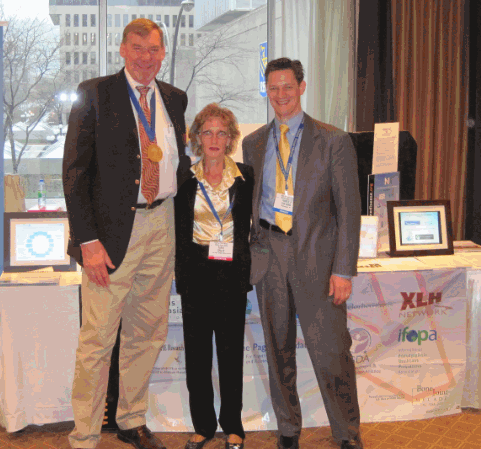

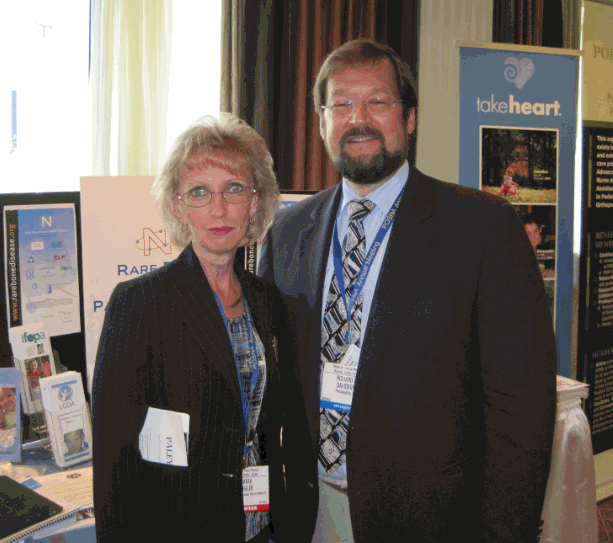


| Dr. Benjamin A. Alman |

| Hot Off The Newswire 2010 |
| The 8 Annual International Pediatric Orthopaedic Symposium (IPOS) was held in Dec 7-10, 2011presented by POSNA and AAOS This year Dr. Scott Kozin presented, Masters Technique: management of the MHE forearm and Dr. Dror Paley presented, Treating the MHE ankle deformities. The MHE Research Foundation also had an educational display during this conference. The MHE Research Foundation would like to express its gratitude to POSNA, AAOS, the leadership of these Societies and doctors Paley and Kozin whom serve on the Medical Advisory Board of our foundation for their support in the improvement of the clinical care MHE patients receive through all of the continuing educational efforts. |
| The MHE Research Foundation Partnering in Advocacy and Education with the Musculoskeletal Tumor Society (MSTS) and the Connective Tissue Oncology Society (CTOS) during the Oct 26-29, 2011 joint conference held in Chicago Our Foundation would like to express our thanks to MSTS and CTOS for all of there continuing support of our efforts |


| Dr. Richard Lackman 2011 President of MSTS and long time supporter. Dr. Lackman is Porfessor and Director, Sarcoma Center of Excellence at the Abramson Cancer Center of the University of Pennsylvania |
| Dr. Lor Randal 2011 President of CTOS and member of our Foundations advisory board along with Sarah Ziegler and Dr. Kevin Jones. Dr. Randal is Director of Huntsman Cancer Institutes' Sarcoma Service, where Dr. Jones is also located and conducting MHE Research |

| Stay tuned more information concerning The 3rd Annual SBMRI Rare Disease Symposium will be posted shortly Click Here for a preview |
| HIGH IMPORTANCE Please register your contact information with MHE Research Foundations |
| Hot Off The Newswire 2012 |
| The 3rd Annual SBMRI Rare Disease Symposium held Feb 24, 2011. Once again supported by our foundation, to view the video presentations during this symposium Click Here |

Autism-like socio-communicative deficits and stereotypies in mice lacking heparan sulfate.
Irie F, Badie-Mahdavi H, Yamaguchi Y.
Proc Natl Acad Sci U S A. 2012 Mar 12.
HSPG-Deficient Zebrafish Uncovers Dental Aspect of Multiple Osteochondromas.
Wiweger MI, Zhao Z, van Merkesteyn RJ, Roehl HH, Hogendoorn PC.
PLoS One. 2012;7(1):e29734. Epub 2012 Jan 11.
To read this full text publication Click here
Epiphyseal growth plate and secondary peripheral chondrosarcoma the neighbours matter.
J Pathol. 2012 Jan;226(2):219-28. doi: 10.1002/path.3003. Epub 2011 Nov 23.
de Andrea CE, Hogendoorn PC.
To read this full text publication Click here
Identification and functional characterization of the human EXT1 promoter region.
Jennes I, Zuntini M, Mees K, Palagani A, Pedrini E, De Cock G, Fransen E, Vanden Berghe W, Sangiorgi L, Wuyts W.
Gene. 2012 Jan 15;492(1):148-59. Epub 2011 Oct 19.
Irie F, Badie-Mahdavi H, Yamaguchi Y.
Proc Natl Acad Sci U S A. 2012 Mar 12.
HSPG-Deficient Zebrafish Uncovers Dental Aspect of Multiple Osteochondromas.
Wiweger MI, Zhao Z, van Merkesteyn RJ, Roehl HH, Hogendoorn PC.
PLoS One. 2012;7(1):e29734. Epub 2012 Jan 11.
To read this full text publication Click here
Epiphyseal growth plate and secondary peripheral chondrosarcoma the neighbours matter.
J Pathol. 2012 Jan;226(2):219-28. doi: 10.1002/path.3003. Epub 2011 Nov 23.
de Andrea CE, Hogendoorn PC.
To read this full text publication Click here
Identification and functional characterization of the human EXT1 promoter region.
Jennes I, Zuntini M, Mees K, Palagani A, Pedrini E, De Cock G, Fransen E, Vanden Berghe W, Sangiorgi L, Wuyts W.
Gene. 2012 Jan 15;492(1):148-59. Epub 2011 Oct 19.
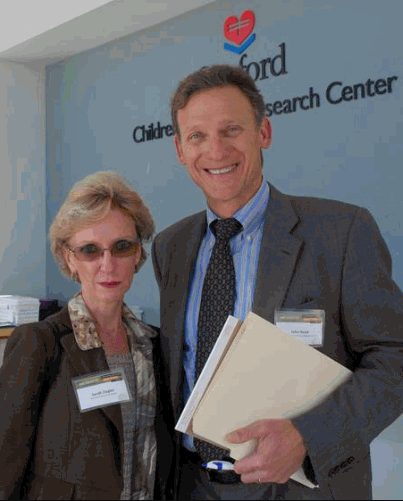
Sarah Ziegler and
Dr. John Reed CEO for the Sanford-Burnham
Dr. John Reed CEO for the Sanford-Burnham

| PRESS RELEASE RESEARCH & THE SANFORD-BURNHAM MARCH 12, 2012 |
Yu Yamaguchi's research on "MHE" reveals new insights into autism, these findings also provide new
insights for the general autistic population Click here to read the extensive press release
insights for the general autistic population Click here to read the extensive press release